
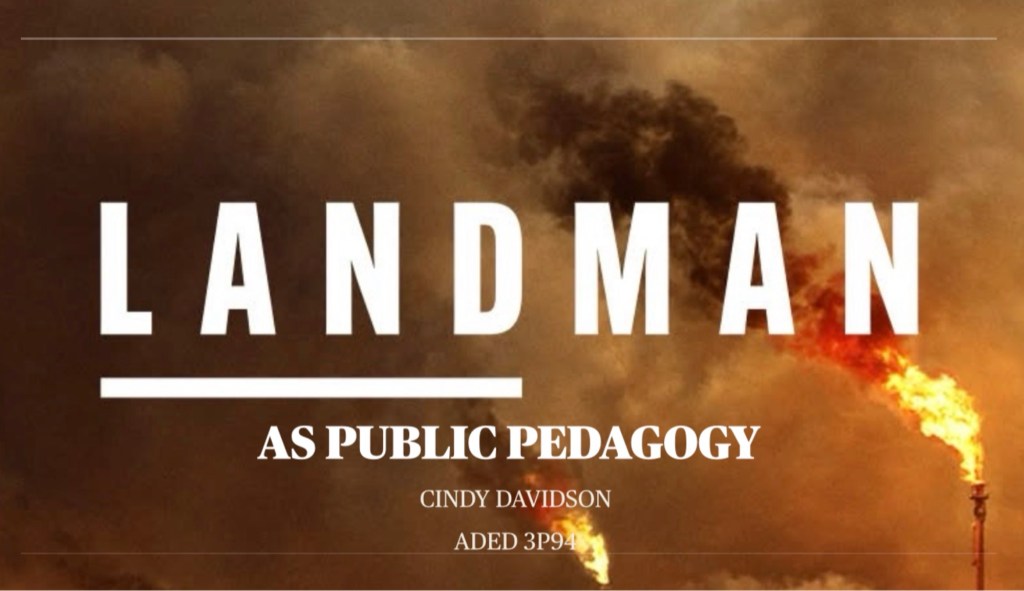
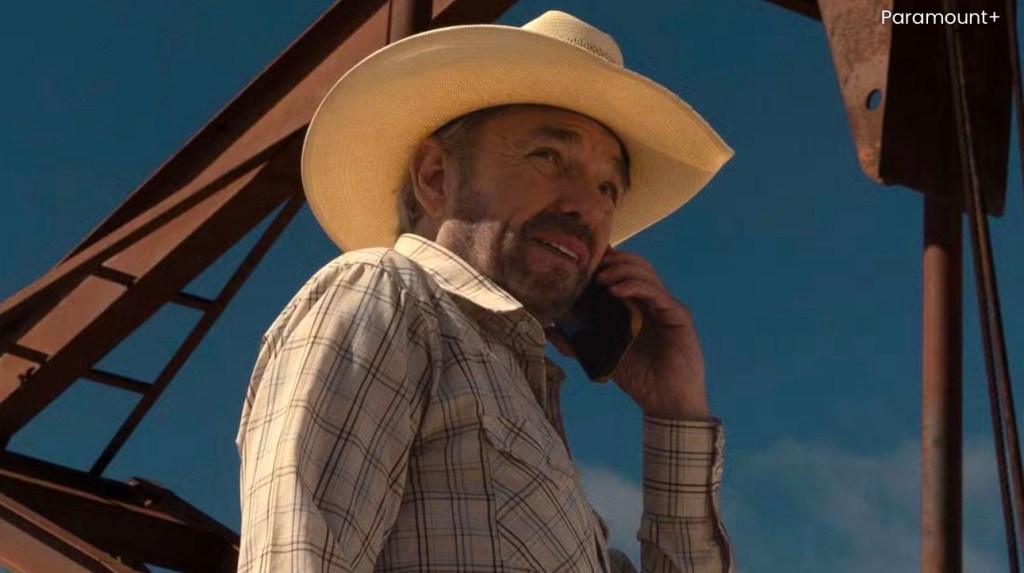
Landman (Wallace et al., 2024 – present), is a television series streaming on Paramount +, that originally aired late 2024 and is now in production for its third season, set to be released in early 2027. It follows the operations of the fictional independent oil producer, M-Tex Oil, with the plot focusing on the daily life of the main character Tommy Norris, played by Billy Bob Thornton, in the role of a Landman, the equivalent of a Chief Operating Officer, as he navigates various issues associated with his role: negotiating surface land leases for exclusive use of private property, where M-Tex Oil owns the subsurface mineral rights, and needs access in order to drill oil and gas wells; responding to incidents in the oil field from an occupational health and safety and risk mitigation perspective, and investigating workplace incidents, injuries, and deaths; and overseeing drilling and exploration operations, crew camps, and various aspects of human resource management.
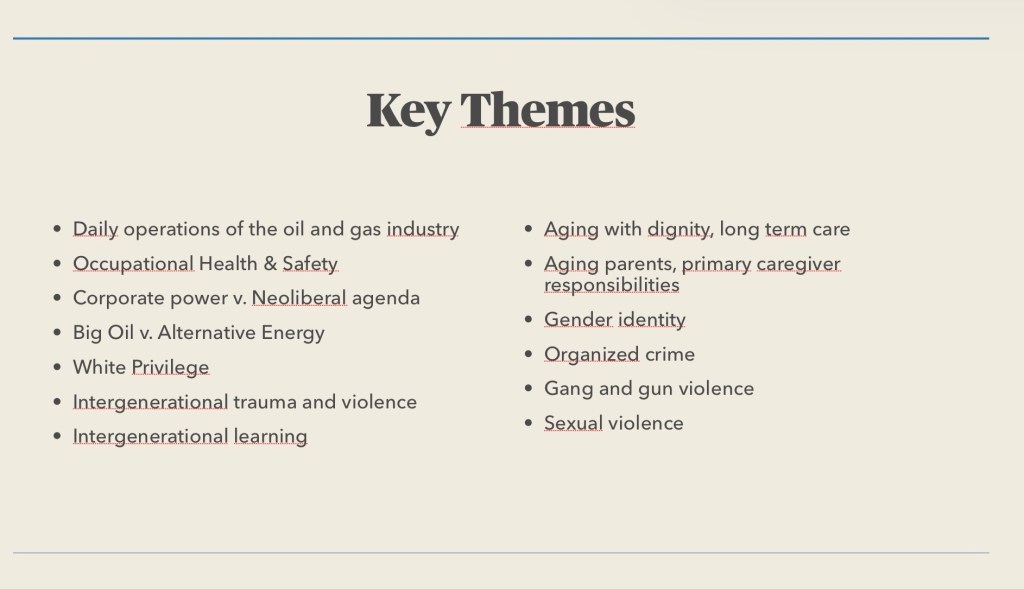
There are several emergent themes in Landman, originating with oil and gas exploration and production, with all its inherent risks; however, some are sensationalized, and unrealistic, demonstrating more artistic expression than realism.
As one of my favourite television series, having binge watched it in its entirety several times, I was drawn to it initially for its counter to the left-wing progressive political narrative that seems prevalent in today’s society; however, I soon realized that Landman was multifaceted, and not a one-dimensional narrative that strictly espoused neoliberal ideology, though it does lean strongly on capitalist realism (Garcia, 2015), as it fleshes out the majority of its characters early in season one.
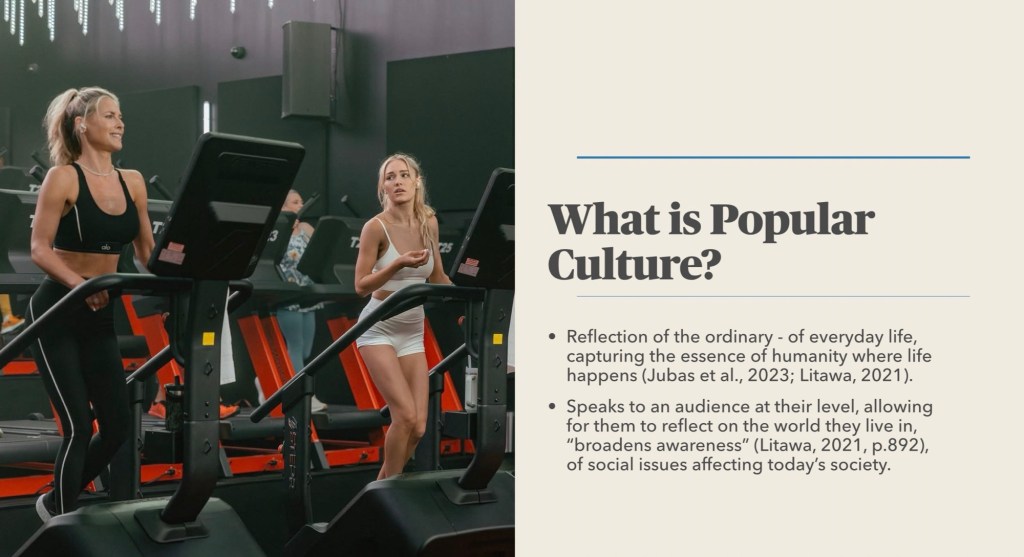
When I consider what popular culture is — a reflection of humanity where it occurs (Jubas et al., 2021), whether that is somewhere in the margins of society, perhaps appearing as street art (Litawa, 2021), challenging the juxtaposition of extreme poverty and extreme wealth; or in a local coffee shop, consuming designer coffee in designer jeans, espousing capitalism while sharing environmentalist poetry at an open mic night — and how it can be used in the context of adult learning, Landman was my clear choice for a pop culture artifact, to be further examined through the lens of public pedagogy.
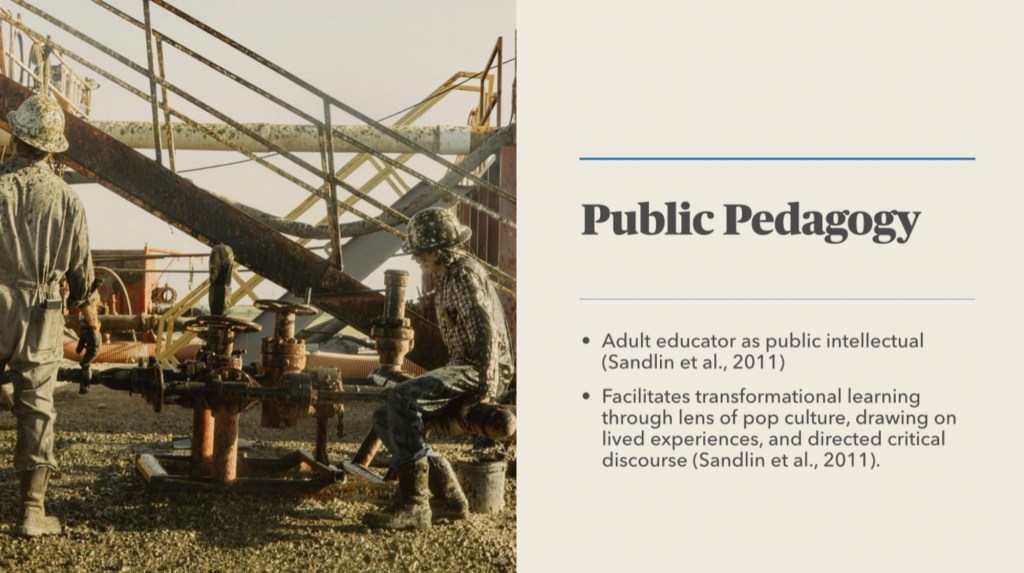
As an adult educator, my professional practice has predominantly been rooted in non-formal, structured, workplace learning, or in informal learning in the public space, as an indigenous rights activist; in politics, through the creation of political campaign content, as a candidate for provincial legislature; and as a content creator for educational materials associated with grassroots social movements. Sandlin et al., (2011) consider participation in this realm of adult education engagement, as being a public intellectual, whose roll is to facilitate adult learning across the lifespan, with a focus more specifically on transformational learning — making meaning of, and growing from, one’s lived experiences. Landman gives us the raw materials needed to begin the public discourses that are necessary to facilitate learning; however, our job as adult educator, is not to influence the adult public on what to think, rather to foster critical thought throughout the transformational learning process.
While pursuing graduate studies in the field of aboriginal education, as an applied adult educational researcher, I was drawn to various indigenous methodologies, requiring me to extrapolate from a variety of interdisciplinary sources of indigenous methodologies and pedagogical frameworks, to apply to my own adult education research in workplace learning. I continue to challenge myself, as a means of my own informal learning, to apply indigenous methodologies while currently pursuing professional development, which is the rationale I used for applying trickster methodology (East, 2023; Hensley, 2018) to the narrative of Landman.
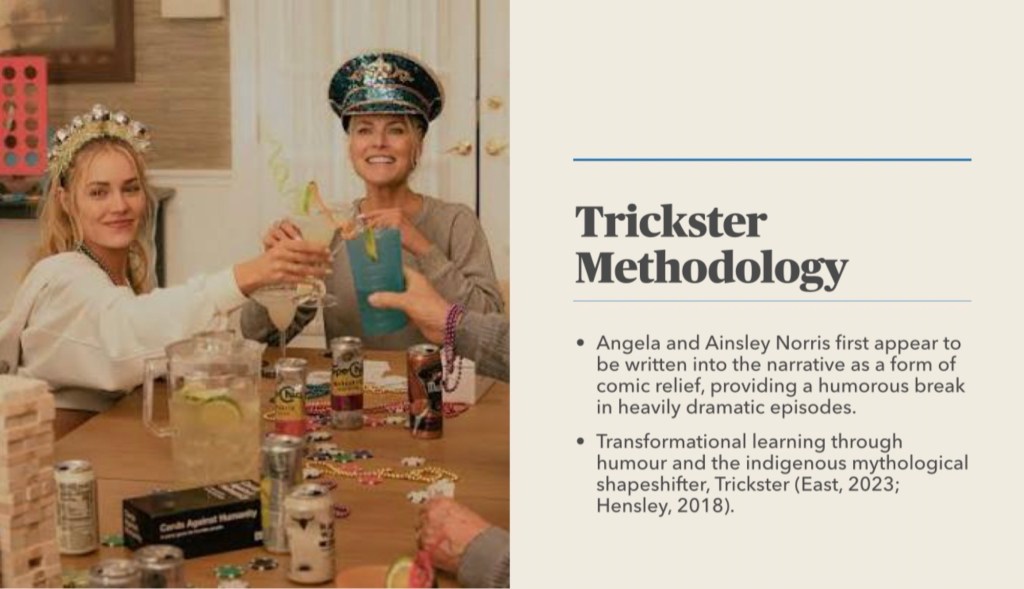
We are first introduced to the characters of Angela and Ainsley Norris, the mother-daughter duo played by Ali Larter and Michelle Randolph respectively; early critique of these characters across social media suggested their role was comic relief oriented and superfluous to the main storyline and character development, however, when we apply trickster methodology to the narratives involving Angela and Ainsley, we see more complex characters emerging. In the scene depicted above, the mother-daughter duo have taken on a philanthropic role, volunteering at a local long term care facility. We are able to observe how the role of humour is used intentionally, to enhance the pedagogical value of the scene, as it explores issues in aging with dignity, and how it applies to creating public space for fourth age learning (Findsen & Formosa, 2011), supporting experiential and transformational learning for the oldest members of society, confined to long term care facilities, to help them make meaning of their lived experiences while enhancing their overall quality of life.
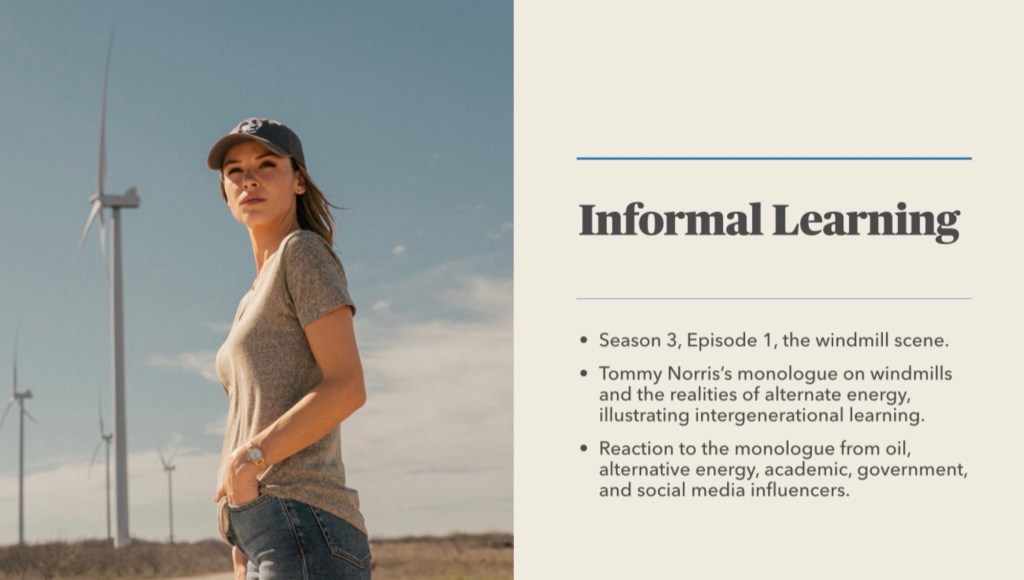
One of the key informal learning takeaways, for me, regarding Landman as public pedagogy, is the extent of the reach and power of popular culture on influencing social narratives. In the Windmill Scene, episode 3, season 1, (Paramount+, 2024, November 27), where an intergenerational learning exchange between Tommy Norris, and the M-Tex contracted corporate attorney, Rebecca Falcone, played by Kayla Wallace, occurs after Rebecca queries Tommy about the wind turbines in the area of the oil fields.
Where my informal learning occurred was in the magnitude of the public discourse that resulted from viewers at all levels of society, critiquing the politically motivated narrative and the factual accuracy of Tommy’s monologue.
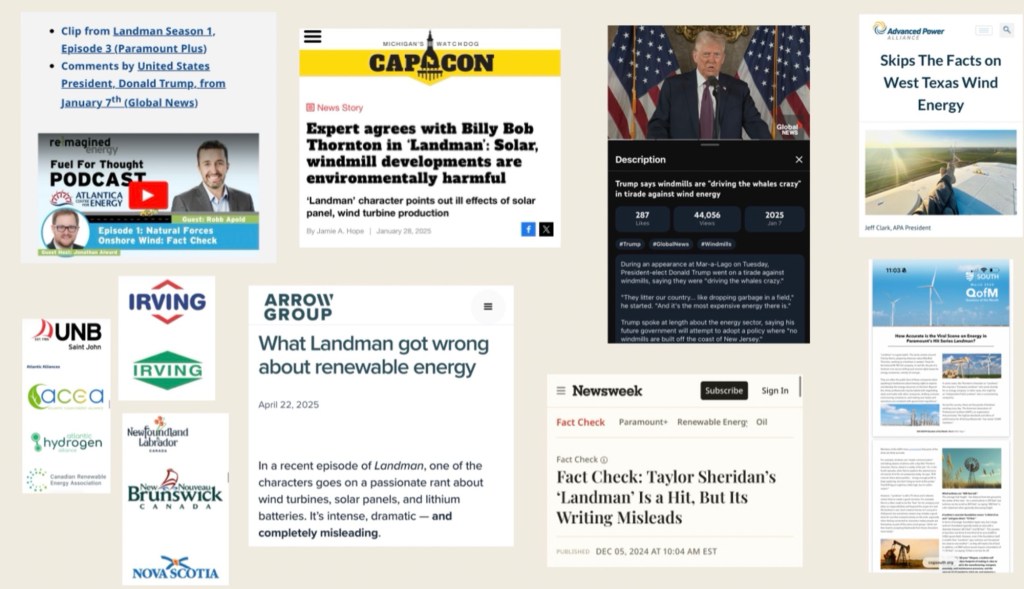
After a brief Google search, using the keywords ‘Landman + Windmill Scene’, I was genuinely surprised at how much discourse was available across a variety of media sources, and at varying levels of both subjective and objective critiques. The image above is a small sampling, and what made them noteworthy to me, was who, and which agency responded, and how they differed in their approach to criticism; the various interpretations of the content of the monologue, and how their criticism was intended to drive their political narratives. The interesting observations and resulting conclusion I came to, was firstly, that there was validity in the narrative, however, it seems to have embellished some of the statistics it quoted; and lastly, I was intrigued by how popular culture was used, and by whom it was used, to drive public policy, noting that everyone from social media influencers to corporate and government working groups on fossil fuels and on alternative energy, to mainstream media, to academia, weighed in on four minutes of popular culture content, adding their voices to the argument in favour of the validity of pop culture, more specifically Landman, as public pedagogy.
References
East, T. (2023). The Trickster Methodology: Describing the Creative Process of Fiction Writers. Journal of Writing in Creative Practice 16(1), pp.7-29. https://doi.org/10.1386/jwcp_00043_1
Findsen, B. & Formosa, M. (2011). Lifelong Learning in Later Life: A Handbook on Older Adult Learning. Sense Publishers.
Garcia, J. (2015). Learning from Bad Teachers: The Neoliberal Agenda for Education in the Popular Media. Critical Education, 6(13), pp. 1-17.
Hensley, N. (2018). Transforming Higher Education Through Trickster-Style Teaching. Journal of Cleaner Production 194(1), pp.607-612. https://doi.org/10.1016/j,jclepro.2018.05.16
Jubas, K., Taber, N., & Brown, T. (2015). Approaching Popular Culture as Pedagogy. In Jubas, K., Taber, N., & Brown, T. (Eds.), Popular Culture as Pedagogy: Research in the Field of Adult Education (pp. 1-10). BRILL.
Litawa, A. (2023). On Popular Art as a Source of Adult Learning. Pedagogy, Culture & Society, 31(5), pp.887-898. https://doi.org/10.1080/14681366.2021.1954987
Paramount Plus (2024, November 27). Landman: Tommy Explains Why Even Wind Turbines Depend on the Oil Industry (S1, E3). [Video]. YouTube. https://youtu.be/fmbZwxEnAFc?si=NB5TXX66tEVCO8wi
Sandlin, J. A., Wright, R. R., & Clark, C. (2011). Re-examining Theories of Adult Learning and Adult Development Through the Lenses of Public Pedagogy. Adult Education Quarterly, 63(1), pp. 3-23. https://doi.org/10.1177/0741713611.4.5836
Wallace, C., Sheridan, T., Glasser, D. C., Hutkin, D., Burkle, R., Yari, B., Kosinski, G., Friedkin, D., Hoch, J., Brown, S., Creydt, M., Feldman, M., Kay, S., & Nickell, J.K. (Executive Producers). (2024 – present). Landman. Imperative Entertainment; Texas Monthly; Bosque Ranch Productions; 101 Studios; Paramount Television Studios; Paramount+.

