
Landman as Public Pedagogy

Landman (Wallace et al., 2024 – present), is a television series streaming on Paramount +, that originally aired late 2024 and is now in production for its third season, set to be released in early 2027. It follows the operations of the fictional independent oil producer, M-Tex Oil, with the plot focusing on the daily life of the main character Tommy Norris, played by Billy Bob Thornton, in the role of a Landman, the equivalent of a Chief Operating Officer, as he navigates various issues associated with his role: negotiating surface land leases for exclusive use of private property, where M-Tex Oil owns the subsurface mineral rights, and needs access in order to drill oil and gas wells; responding to incidents in the oil field from an occupational health and safety and risk mitigation perspective, and investigating workplace incidents, injuries, and deaths; and overseeing drilling and exploration operations, crew camps, and various aspects of human resource management.

There are several emergent themes in Landman, originating with oil and gas exploration and production, with all its inherent risks; however, some are sensationalized, and unrealistic, demonstrating more artistic expression than realism.
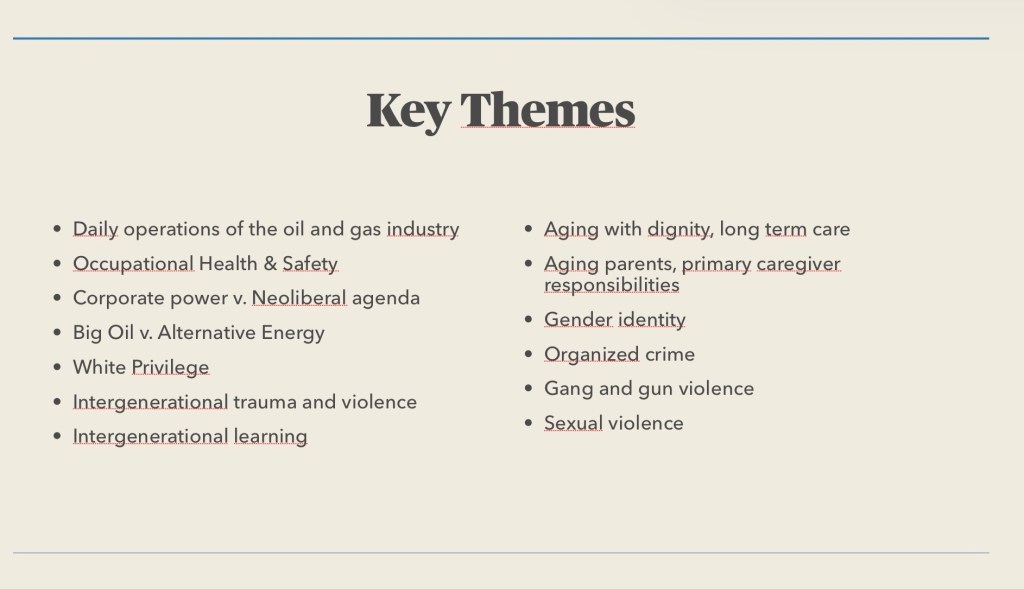
As one of my favourite television series, having binge watched it in its entirety several times, I was drawn to it initially for its counter to the left-wing progressive political narrative that seems prevalent in today’s society; however, I soon realized that Landman was multifaceted, and not a one-dimensional narrative that strictly espoused neoliberal ideology, though it does lean strongly on capitalist realism (Garcia, 2015), as it fleshes out the majority of its characters early in season one.
When I consider what popular culture is — a reflection of humanity where it occurs (Jubas et al., 2021), whether that is somewhere in the margins of society, perhaps appearing as street art (Litawa, 2021), challenging the juxtaposition of extreme poverty and extreme wealth; or in a local coffee shop, consuming designer coffee in designer jeans, espousing capitalism while sharing environmentalist poetry at an open mic night — and how it can be used in the context of adult learning, Landman was my clear choice for a pop culture artifact, to be further examined through the lens of public pedagogy.

As an adult educator, my professional practice has predominantly been rooted in non-formal, structured, workplace learning, or in informal learning in the public space, as an indigenous rights activist; in politics, through the creation of political campaign content, as a candidate for provincial legislature; and as a content creator for educational materials associated with grassroots social movements. Sandlin et al., (2011) consider participation in this realm of adult education engagement, as being a public intellectual, whose roll is to facilitate adult learning across the lifespan, with a focus more specifically on transformational learning — making meaning of, and growing from, one’s lived experiences. Landman gives us the raw materials needed to begin the public discourses that are necessary to facilitate learning; however, our job as adult educator, is not to influence the adult public on what to think, rather to foster critical thought throughout the transformational learning process.
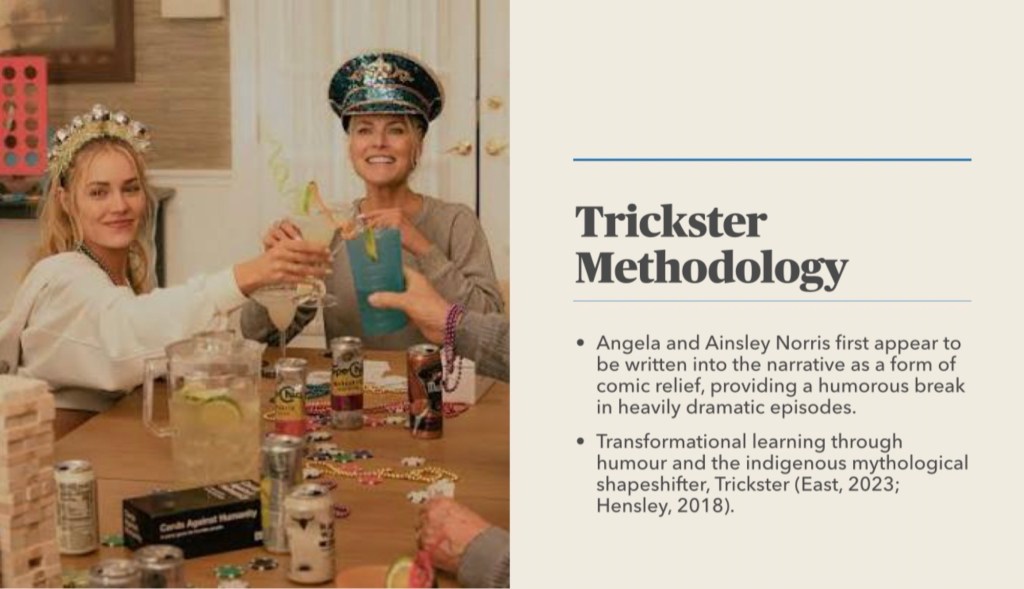
While pursuing graduate studies in the field of aboriginal education, as an applied adult educational researcher, I was drawn to various indigenous methodologies, requiring me to extrapolate from a variety of interdisciplinary sources of indigenous methodologies and pedagogical frameworks, to apply to my own adult education research in workplace learning. I continue to challenge myself, as a means of my own informal learning, to apply indigenous methodologies while currently pursuing professional development, which is the rationale I used for applying trickster methodology (East, 2023; Hensley, 2018) to the narrative of Landman.

We are first introduced to the characters of Angela and Ainsley Norris, the mother-daughter duo played by Ali Larter and Michelle Randolph respectively; early critique of these characters across social media suggested their role was comic relief oriented and superfluous to the main storyline and character development, however, when we apply trickster methodology to the narratives involving Angela and Ainsley, we see more complex characters emerging. In the scene depicted above, the mother-daughter duo have taken on a philanthropic role, volunteering at a local long term care facility. We are able to observe how the role of humour is used intentionally, to enhance the pedagogical value of the scene, as it explores issues in aging with dignity, and how it applies to creating public space for fourth age learning (Findsen & Formosa, 2011), supporting experiential and transformational learning for the oldest members of society, confined to long term care facilities, to help them make meaning of their lived experiences while enhancing their overall quality of life.
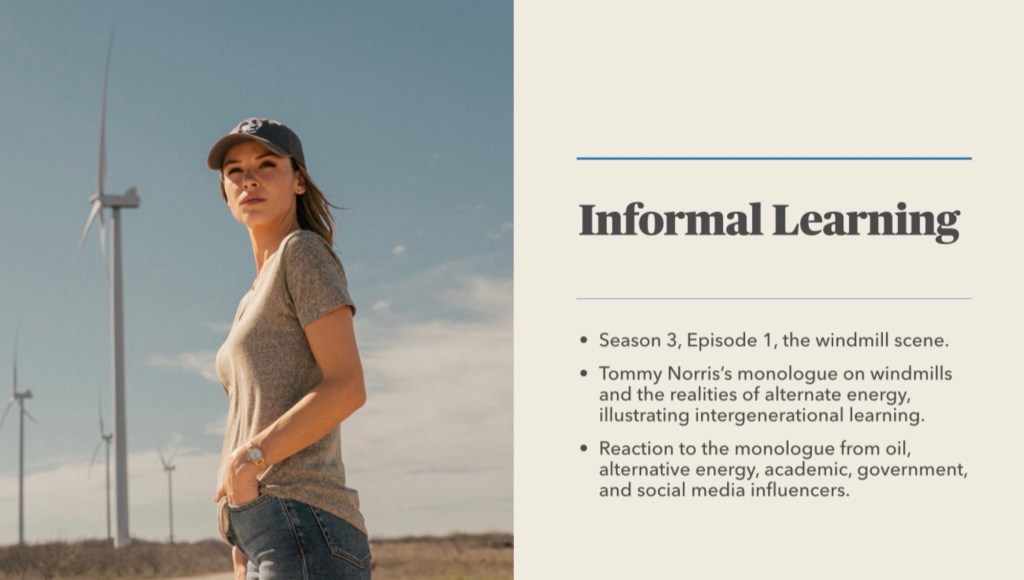
One of the key informal learning takeaways, for me, regarding Landman as public pedagogy, is the extent of the reach and power of popular culture on influencing social narratives. In the Windmill Scene, episode 3, season 1, (Paramount+, 2024, November 27), where an intergenerational learning exchange between Tommy Norris, and the M-Tex contracted corporate attorney, Rebecca Falcone, played by Kayla Wallace, occurs after Rebecca queries Tommy about the wind turbines in the area of the oil fields.
Where my informal learning occurred was in the magnitude of the public discourse that resulted from viewers at all levels of society, critiquing the politically motivated narrative and the factual accuracy of Tommy’s monologue.

After a brief Google search, using the keywords ‘Landman + Windmill Scene’, I was genuinely surprised at how much discourse was available across a variety of media sources, and at varying levels of both subjective and objective critiques. The image above is a small sampling, and what made them noteworthy to me, was who, and which agency responded, and how they differed in their approach to criticism; the various interpretations of the content of the monologue, and how their criticism was intended to drive their political narratives. The interesting observations and resulting conclusion I came to, was firstly, that there was validity in the narrative, however, it seems to have embellished some of the statistics it quoted; and lastly, I was intrigued by how popular culture was used, and by whom it was used, to drive public policy, noting that everyone from social media influencers to corporate and government working groups on fossil fuels and on alternative energy, to mainstream media, to academia, weighed in on four minutes of popular culture content, adding their voices to the argument in favour of the validity of pop culture, more specifically Landman, as public pedagogy.

References

East, T. (2023). The Trickster Methodology: Describing the Creative Process of Fiction Writers. Journal of Writing in Creative Practice 16(1), pp.7-29. https://doi.org/10.1386/jwcp_00043_1

Findsen, B. & Formosa, M. (2011). Lifelong Learning in Later Life: A Handbook on Older Adult Learning. Sense Publishers.

Garcia, J. (2015). Learning from Bad Teachers: The Neoliberal Agenda for Education in the Popular Media. Critical Education, 6(13), pp. 1-17.

Hensley, N. (2018). Transforming Higher Education Through Trickster-Style Teaching. Journal of Cleaner Production 194(1), pp.607-612. https://doi.org/10.1016/j,jclepro.2018.05.16

Jubas, K., Taber, N., & Brown, T. (2015). Approaching Popular Culture as Pedagogy. In Jubas, K., Taber, N., & Brown, T. (Eds.), Popular Culture as Pedagogy: Research in the Field of Adult Education (pp. 1-10). BRILL.

Litawa, A. (2023). On Popular Art as a Source of Adult Learning. Pedagogy, Culture & Society, 31(5), pp.887-898. https://doi.org/10.1080/14681366.2021.1954987

Paramount Plus (2024, November 27). Landman: Tommy Explains Why Even Wind Turbines Depend on the Oil Industry (S1, E3). [Video]. YouTube. https://youtu.be/fmbZwxEnAFc?si=NB5TXX66tEVCO8wi

Sandlin, J. A., Wright, R. R., & Clark, C. (2011). Re-examining Theories of Adult Learning and Adult Development Through the Lenses of Public Pedagogy. Adult Education Quarterly, 63(1), pp. 3-23. https://doi.org/10.1177/0741713611.4.5836

Wallace, C., Sheridan, T., Glasser, D. C., Hutkin, D., Burkle, R., Yari, B., Kosinski, G., Friedkin, D., Hoch, J., Brown, S., Creydt, M., Feldman, M., Kay, S., & Nickell, J.K. (Executive Producers). (2024 – present). Landman. Imperative Entertainment; Texas Monthly; Bosque Ranch Productions; 101 Studios; Paramount Television Studios; Paramount+.

Comparing impact and outcome evaluation

What characterizes impact and outcome evaluations? How do they differ? How are they used in professional practice?  At the outset, some of the answers seemed straightforward: Impact evaluation assesses short term program outcomes, and outcome evaluation assesses the long term reach of the program (PACE mySPH, 2012, December 11).  Yet, the more each evaluation approach was examined, the more difficult and confusing the answers became, as each resource defined the approaches, and how they were used in practice differently, and in some instances used similar definitions in each account of impact and outcome evaluation in practice.

Impact Evaluation

The Organisation for Economic Co-operation and Development (OECD, n.d.) suggests that impact evaluation be used at the outset of program planning, for innovative or new programs, to assess whether or not the programs are meeting the short-term needs of the participants, or to determine which aspects of a program are working or not.  Contrastingly, the Centers for Disease Control and Prevention (CDCa, n.d; CDCb, n.d.) suggest that impact evaluations are utilized to determine the widespread outcomes of a program (community transformation), by using statistics collected over time to determine how effective the intervention has been (i.e.: to determine if a pre-natal care community public health initiative is positively affecting change on a community, infant mortality rates, rates and severity of infant/childhood illness, etc. are assessed).  Interestingly, the CDC contradicts itself when it suggests that impact evaluation is used at the end of a program, to measure the long-term impacts of a program on a community (CDCb, n.d.), and that it is used at intervals when a program is ongoing, in short-term and medium-term ranges, to determine its ongoing effects on the target audience (CDCa, n.d.).  Owen (2007) also gives alternative usages for impact evaluation, suggesting it is used “to assess the effects of a settled program” (p.47), as well as echoing the CDC, that impact evaluation can also be used at intervals, such as a mid-point evaluation.  Khandker, Koolwal and Samad summarize impact evaluation as an assessment means to “help policy makers decide whether programs are generating intended effects; to promote accountability in the allocation of resources across public programs; and to fill gaps in understanding what works, what does not, and how measured changes in well-being are attributable to a particular project or policy intervention” (2010, p.3), which combines aspects of the OECD and CDC definitions.

Outcome Evaluation

Outcome evaluation “measures effect and changes that result from the campaign. Investigates to what extent the communication program/intervention is achieving its outcomes in the target populations” (CDCb, n.d., p.2), which is a similar definition to impact evaluation, creating confusion between the two approaches.  One contrast between outcome and impact evaluation focuses on who benefits from the program being evaluated; outcome evaluation seeks to assess how individuals are transformed during and after completion of a program (McNamara, n.d.), in contrast to evaluating community based transformation during impact evaluation. There is notable exception to the individual (outcome) vice community (impact) evaluation description simplification; the Centers for Disease Control and Prevention describe outcome evaluation as targeting the affects of programming on a specific population (CDCa).

This ambiguity in definition and usage makes it difficult to determine how best to utilize impact and outcome evaluation in professional practice. Which approach is best used to determine overall outcomes (transformations) of a program on a specific community? Alternatively, is it more pertinent to use impact evaluation to determine how well each component of a program is functioning with respect to meeting program goals?  How does the practitioner determine which evaluation approach is the best fit for each program to be evaluated?

References

Centers for Disease Control and Prevention [CDCa]. (n.d.). Types of evaluation [Web page].  Retrieved from: https://www.cdc.gov/std/Program/pupestd/Types%20of%20Evaluation.pdf

Centers for Disease Control and Prevention [CDCb]. Building Our Understanding: Key Concepts of Evaluation, What is it and how do you do it? Retrieved from: https://www.cdc.gov/nccdphp/dch/programs/healthycommunitiesprogram/tools/pdf/eval_planning.pdf

Khander, S.R., Koolwal, G.B., and Samad, H.A. (2010). Handbook on impact evaluation: Quantitative methods and practices. Washington, D.C.: The World Bank.

McNamara, C. (n.d). Basic guide to outcomes-based evaluation for nonprofit organizations with very limited resources [Web page]. Retrieved from: http://managementhelp.org/evaluation/outcomes-evaluation-guide.htm

Organisation for Economic Co-operation and Development [OECD]. Outline of principles of impact evaluation [Web page]. Retrieved from:http://www.oecd.org/dac/evaluation/dcdndep/37671602.pdf

Owen, J.M. (2007). Program evaluation: Forms and approaches (3rd ed.). New York, NY: The Guilford Press.

PACE mySPH. (2012, December 11). Types of evaluation? [Video file]. Retrieved from https://www.youtube.com/watch?v=IgwvRiGm42

Reflections on Sternberg

After reflecting on the concept of ‘self-conscious capitalism’ (Davidson,2016, November 3), within the scope of course content, it became evident that further inquiry into the philosophical underpinnings of capitalism were necessary.  Elaine Sternberg (2015) provided thought provoking discourse that defines capitalism in its purest form (laissez-faire capitalism), as “an economic system characterised by comprehensive private property, free-market pricing, and the absence of coercion” (p. 385), asserting that other, perverse forms of capitalism that engage in coercive practices, are not true representations of capitalist ideology.  Is calling for a responsible, decolonized, sustainable form of capitalism really ‘absent of coercion’?

At this point it is prudent to define coercion as “the non-consensual initiation of physical force, fraud, or the threat thereof by a person or persons against other persons or their property” (Sternberg, 2015, p.386); would the colonial exploitation of Indigenous lands, resources, culture, and language be considered coercive?  If so, the ‘absence of coercion’ would, logically, be the antithesis of colonial ideology — decolonization and reconciliation.  Would Sternberg agree that ‘self-conscious capitalism’ presented as a viable form of capitalism ‘absent of coercion’?

Perhaps not yet!  Sternberg (2015) continues her discussion on coercion, and suggests that regulation, taxation, and other forms of government control of private property constitute forms of coercion, “a society with a government may be allowed the unqualified label ‘capitalist’ if — but only if — the government is minimally coercive” (p.387).  How coercive is the Truth and Reconciliation Commission of Canada: Calls to Action (2015) perceived to be?  If federally mandated action toward reconciliation in the corporate sector is deemed more than ‘minimally coercive’, then ‘self-conscious capitalism’ would prove to be coercive — what Sternberg (2015) would consider as a form of political capitalism, deserving of criticism in its own right.

References

Davidson, C.M. (2016, November 3). Re: Cindy – On Mayo: A queer argument for reconciliation? [Online discussion forum comment].  Retrieved from: https://onq.queensu.ca/d2l/le/69911/discussions/threads/1495166/ViewPostInContext?postId=4689173#post4689173

Sternberg, E. (2015). Defining capitalism. Economic Affairs, 35(3), 380-396.

Truth and Reconciliation Commission of Canada. (2015). Truth and Reconciliation Commission of Canada: Calls to action.  Winnipeg, MB: Author.

How do I feel about innovation in teaching and learning?

When I first selected this course (PME811), I had high hopes for what I would accomplish this semester in relation to the area of professional inquiry I have focused on throughout the Professional Master of Education (Aboriginal Education) program.  The course was not what I expected, however, I did come away from it with new direction for my professional inquiry.  Had it not been for course content and instructor discourse that challenged my assumptions on historical and philosophical thinking, I would not have revisited Alfred (2009), and other Indigenous scholars, nor would I have reframed my thinking on decolonization in an organizational (corporate) context.

Revisiting my research questions for inquiry specific to this course:

  1. How does innovation in teaching and learning relate to the reconciliation process for the corporate sector?
  2. What are the implications for Indigenizing organizational learning?

I can ascertain that I have yet to fully realize answers to each question.  In order to do so, more theorizing about ‘self-conscious capitalism’ (Davidson, 2016, November 3), and its implications on Indigenizing organizational learning is necessary.  Have I fully developed a viable concept in ‘self-conscious capitalism’?  Is there any current research work being done in this area?  If there is, where is my work positioned within its contexts?  Do I have reasonable expectations of completing this inquiry before the end of this course?

References

Davidson, C.M. (2016, November 3). Re: Cindy – On Mayo: A queer argument for reconciliation? [Online discussion forum comment].  Retrieved from: https://onq.queensu.ca/d2l/le/69911/discussions/threads/1495166/ViewPostInContext?postId=4689173#post4689173

Alfred, T. (2009). Peace, power, righteousness: An Indigenous manifesto (2nd ed.). Don Mills, ON: Oxford University Press.

Reflecting on ethnomethodology: fighting the familiar

After reading Morriss (2016), I am wondering if her discourse on familiarity and ethnomethodology have any bearing on my own professional inquiry processes and products?  Familiarity in this sense refers to the position of the inquirer within her area of inquiry — as an ‘insider’, does my Indigeneity lend legitimacy to my inquiry, or does the familiarity inherent to belonging to the group I am focusing my inquiry upon, act to hinder my progress?

Hartley (2007) posits “by intentionally disrupting the individual’s definition of reality, ethnomethodologists are concerned, first, to remind us how provisional that reality is and, second, to observe how individuals re-build their definition of the situation in the face of absurdity and meaninglessness” (p. 203); is ethnomethodology, then, a viable lens in which to explore decolonization and ‘self-conscious capitalism’ (Davidson, 2016, November 3)?  Is the purpose of my area of inquiry (intentional Indigenization of organizational learning) ethnomethodological in itself?

References

Davidson, C.M. (2016, November 3). Re: Cindy – On Mayo: A queer argument for reconciliation? [Online discussion forum comment].  Retrieved from: https://onq.queensu.ca/d2l/le/69911/discussions/threads/1495166/ViewPostInContext?postId=4689173#post4689173

Hartley, D. (2007). Organizational epistemology, education and social theory. British Journal of Sociology of Education, 28(2), 195-208.

Morriss, L. (2016). Dirty secrets and being ‘strange’: Using ethnomethodology to move beyond familiarity. Qualitative Research, 16(5), 526-540. DOI: 10.1177/1468794115598194

Decolonization of the organization: Rationale for ‘self-conscious capitalism’

When I first considered extrapolating ideology from Taiaiake Alfred’s discourse on ‘self-conscious traditionalism’ (Alfred, 2009), I was struck by the irony that I was returning to ideology that I had vehemently opposed when discussing Indigenous knowledge preservation, yet now I was using part of the same rationale to argue that a responsible form of capitalism is, indeed, achievable:

I will put forward the notion of a ‘self-conscious capitalism’, one based on the premise that organizations operate from within a framework that recognizes its responsibility to Indigenous peoples, Indigenous laws and governance, land usage treaties, environmental responsibility (including sustainability practices), and one that is open to the idea of a partnership with Indigenous communities for shared economic development and prosperity, that takes into consideration current socio-political and economic factors in the organization’s local area (Davidson, 2016, November 3, emphasis in original).

Perhaps focusing now on decolonization from the perspective of organizational behaviour is appropriate, to move forward.  How does the organization respond to the idea of ‘self-conscious capitalism’?  Is this a viable theory worth developing in response to reconciliation discourse?

References

Davidson, C.M. (2016, November 3). Re: Cindy – On Mayo: A queer argument for reconciliation? [Online discussion forum comment].  Retrieved from: https://onq.queensu.ca/d2l/le/69911/discussions/threads/1495166/ViewPostInContext?postId=4689173#post4689173

Alfred, T. (2009). Peace, power, righteousness: An Indigenous manifesto (2nd ed.). Don Mills, ON: Oxford University Press.

Historical thinking: Talking about residential school legacy in corporate contexts

When I first read the Truth and Reconciliation Commission: Calls to Action (2015), I was struck by the mandate to include residential school legacy as part of the organizational learning curriculum.  How is this applicable to meeting the needs of the organization? To organizational problem solving?  To the workplace in general?

It is the ‘organization first’ mindset that stifles the imagination when it comes to opening the door to talking about the residential school system, Indigenous assimilation practices, and the traumatic and lasting, intergenerational legacy the system produced.

  1. How do we address residential school legacy in relation to today’s post-colonial, yet Eurocentric corporate construct?
  2. In what ways do we challenge the status quo in order to decolonize and reconstruct the corporate construct in ways that embrace Indigenous ways of knowing  in a genuine manner, without cultural appropriation of traditional knowledge?  How does this fit with reconciliation themes?
  3. What role does historical agency (Seixas & Peck, 2004) have in a challenge of this complexity and magnitude?
  4. Through which Indigenous philosophical or pedagogical lens do we proceed? Indigenous leadership? Indigenous feminism? Indigenous self-determination?

Deconstructing the colonial perspectives of the history of residential schools that “had been collectively chosen and publicly enforced” (Toews, 2016, p. 95), will be a priority when attempting to answer these four newly emerging research questions.

References

Seixas, P., and Peck, C. (2004). Teaching historical thinking. In A. Sears, and I. Wright (eds.). Challenges & prospects for Canadian social studies. Vancouver, BC: Pacific Educational Press.

Toews, J.E. (2016). Thinking historically about thinking historically: Is historical theory a historical or metahistorical practice?. History and Theory, 55(2), 99-109.

Indigenous innovation: The quadruple bottom line

For many in the corporate sector, the concept of the  ‘triple bottom line’ (profit, people, planet), introduced by John Elkington in 1994 (Walters & Takamura, 2015), is the standard in sustainability discourse.  Indigenous innovation ideology challenges and decolonizes the triple bottom line, and suggests a fourth ‘bottom line’ approach that is based in cultural and spiritual aspects of sustainable enterprise: community, spirituality, sustainability, and entrepreneurship, with a subset based largely on Indigenous perspectives of cultural, social, economic, and environmental themes (Walters & Takamura, 2015) that provide potential for future creation of sustainable Indigenous economic development.

Within the Truth and Reconciliation Commission of Canada: Calls to Action [TRC], a mandate has been put forth that directly engages the corporate sector in Canada; Section 92 (ii) recommends that businesses, “ensure that Aboriginal peoples have equitable access to jobs, training, and education opportunities in the corporate sector, and that Aboriginal communities gain long-term sustainable benefits from economic development projects” (TRC, 2015, p. 10).  Reconciliation is a direct challenge for adult education practitioners engaging in organizational (workplace) learning.

What role does Indigenous innovation and sustainable Indigenous economic development have on my professional practice?

References

Truth and Reconciliation Commission of Canada [TRC], (2015). Truth and Reconciliation Commission of Canada: Calls to action.  Winnipeg, MB: Author.

Walters, F., and Takamura, J. (2015). The decolonized quadruple bottom line: A framework for developing Indigenous innovation.  Wicazo Sa Review, 30(2), 77-99.

Emergent themes of innovation

It has been cautioned that the term ‘innovation’ has been overused and has taken on such a breadth of meaning, that in some instances its use in educational contexts merely suggests a generalization of  any non-standard or non-traditional approaches to classroom teaching praxis (Kopcha, Rieber & Walker, 2016).  This generalized definition is built upon as the traditional power paradigm in the classroom is challenged, and shifts from didactic, teacher-centred practice, to student-centred peer learning that is both problem and case-based (Layne , Nabeebaccus, Fok, Lams, Thomas & Kinirons, 2010).  Incorporating technology into classroom practice further challenges traditional paradigms, solidifying the change to student-centred learning by adding to learner engagement (Kopcha et al., 2016), and suggesting a proportionate increase in improvement in learning outcomes (Tanaka, 2009).

Emergent themes regarding the term ‘innovation’ in a post-secondary and organizational learning context can be summarized as innovation as a means of improving learning outcomes (Tanaka, 2009); innovation as a means of challenging traditional pedagogies and power paradigms (Layne et al., 2010);  innovation as the use of technology to enhance learner engagement (Kopcha et al., 2016); with he most intriguing being Indigenous innovation, which is organizational learning oriented and defined in terms of sustainable economic development and reconciliation (Walters & Takamura, 2015).

Does ‘Indigenous innovation’ have a valid place within my own research context?

References

Kopcha, T.J., Rieber, L.P., and Walker, B.D. (2016). Understanding university faculty perceptions about innovation in teaching and technology. British Journal of Educational Technology, 47(5), 945-957.

Layne, K., Nabeebaccus, A., Fok, H., Lams, B., Thomas, S., and Kinirons, M. (2010). Modernising morning report: Innovation in teaching and learning. The Clinical Teacher, 7(2), 72-82.

Tanaka, K. (2009). On innovation in teaching rural sociology. Southern Rural Sociology, 24(3), 12-16.

Walters, F. and Takamura, J. (2015). The decolonized quadruple bottom line: A framework for developing Indigenous innovation. Wicazo Sa Review, 30(2), 77-99.


On creativity

“Culture in the broadest sense of the term includes not just the artistic and scholarly products. It encompasses the institutions and practices, rites and rituals, beliefs and skills, attitudes and values, and world views and localized modes of thinking and acting of all members of society over the whole range of contexts” (Martin, 1996, p.6, Italics in original); creativity then, is arguably the cultural stock (products or output) of the original thought and expression of an entire society. Hennessey and Amabile (2010) lend credence to this ideology by suggesting that creativity is the “development of a novel product, idea, or problem solution that is of value to the individual and/or the larger social group” (p. 572); however, this illustrates the inherent commodification of original thought and design that suggests that only the useful products are indeed creative.

This is problematic, as it is exclusive of aspects of creativity that are not directly marketable, such as expressive arts (Valters Painter, 2007), and creativity as a tool for meaning making and coping from a mental health perspective (Cory, Mallet, Lewis & Abdel-Khalek, 2013). When the products of creativity are thought of in terms of creation, a spiritual connection emerges, where it is suggested that creativity is a manifest of the Divine, or “spiritual power given to us by God” (Buckenham, 2011, p.59). Alternatively, traditional Indigenous wisdom envisions creativity as a means of conceptualizing the interconnection and interrelation of all things (Lane, Bopp, Bopp & Brown, 2012), which lends support to the argument of creativity being a therapeutic process (Cory et al.; Valters Painter, 2007).  Personally, this is the ideology I gravitate toward!

References

Buckenham, K. (2011). Creativity and spirituality: Two threads of the same cloth.  Religion & Theology, 18(1), 56-76.

Corry, D.A.S., Mallett, J., Lewis, C.A., and Abdel-Khalek, A.M. (2013). The creativity-spirituality construct and its role in transformative coping. Mental Health, Religion & Culture, 16(10), 979-990.

Hennessey, B. A., and Amabile, T.M. (2010). Creativity. Annual Review of Psychology, 61(1), 569-598.

Lane, P., Bopp, J., Bopp, M., and Brown, L. (2012). The sacred tree: Reflections on Native American spirituality (4th ed.). Twin Lakes, WI: Lotus Press.

Martin, J. R. (1996). There’s too much to teach: Cultural wealth in an age of scarcity. Educational Researcher, 25(2), 4-16.

Valters Painter, C. (2007).  The relationship between spirituality and artistic expression: Cultivating the capacity for imagining. Spirituality in Higher Education Newsletter, 3(2), 1-6.