
As I began the journey in the Professional Master of Eduction program, with Aboriginal Education as my selected field of study, I felt it necessary to develop models of inquiry that were culture-based, and reflective in nature. The Medicine Wheel has been my preferred framework, yet early attempts at depicting a Medicine Wheel inquiry process made sense to me (internally), yet did not clearly articulate the culture-based teachings that were the driving factors of the inquiry process (Figure 1). Peer and instructor feedback indicated a confusion with its usage, and articulated the need to rationalize its usage from a culture-based perspective.
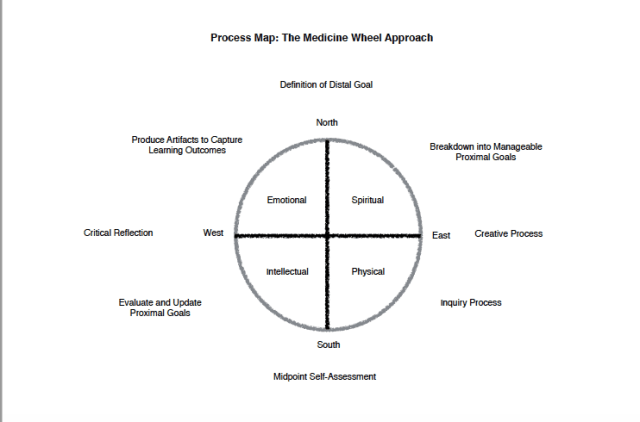
While the intent was to show an holistic (represented by the four aspects of our being), and interconnected inquiry process, the early version failed to capture the gifts of the four directions, “as informed by Cree Elder Michael Thrasher. In the east the gift of vision is found, where one is able to “see” [vision]. In the south one spends time in which to relate to the vision [reflection]. In the west, one uses the gift of reason to figure it out [knowledge building]. In the north, one uses the gift of movement to do or actualize the vision [active inquiry]” (Bell, 2014, p.15). Was the next attempt at using a Medicine Wheel framework (Figure 2), as an advocacy tool, any more successful?
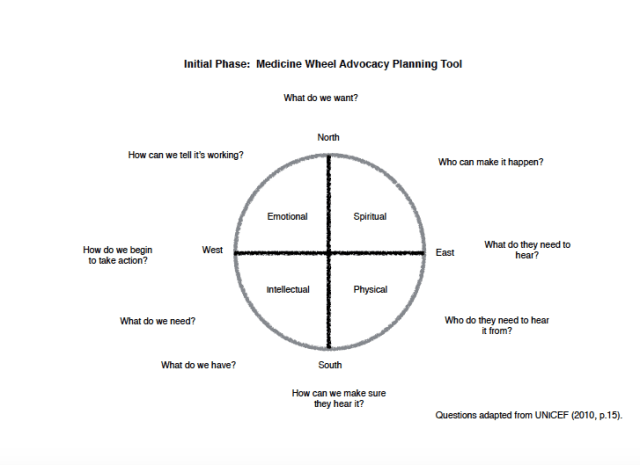
Bell (2014) asserts that “the Medicine Wheel metaphor contains all the traditional teachings and can therefore be used as a guide on any journey, including the educational process [. . .] the underlying web of meaning to Medicine Wheels remains the same: the importance of appreciating and respecting the ongoing interconnectedness and interrelatedness of all things” (p.14); it is this interconnection, and the reflective qualities of the Medicine Wheel, that these early models I created (Figs. 1 & 2) attempted to capture. While Bell (2013) considers using a Medicine Wheel framework “a compass for human understanding” (p.40), as a guide for active and reflective inquiry; Orr (2000) views a Medicine Wheel framework as an active component to reconciliation, “the balance can help to redress the failings of the past and allow people to live differently in the present and future” (p.60). By engaging in an inquiry process that stems from traditional teachings (Figure 3), the Indigenous researcher validates Indigenous knowledge, while building new knowledge bases that transcend the Eurocentric dominance of mainstream academia.
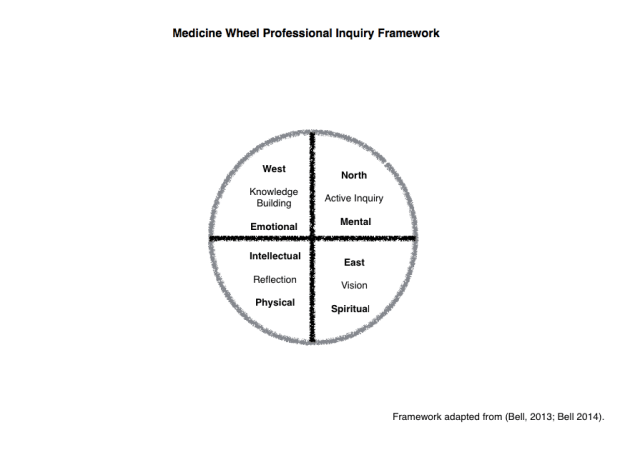
While Bell (2014) maintains there is no correct or incorrect way to travel the Medicine Wheel, the traditional teachings begin the journey in the East, with a specific vision. It is here the inquirer ‘sees’ the research question(s) that form the basis for the professional inquiry. By maintaining a balance between active inquiry, reflection, knowledge building, and keeping focus on the initial research question(s), the inquirer navigates the Medicine Wheel in a holistic manner.
References
Bell, N.(2014). Teaching by the medicine wheel: Anishinaabe framework for Indigenous education. Education Canada, 54(3), 14-16.
Bell, N. (2013). Just do it: Anishinaabe culture-based education. Canadian Journal of Native Education, 36(1), 36-58.
Orr, J.A. (2000). Learning from Native adult education. New Directions for Adult and Continuing Education, 85(1), 59-66.
United Nations Children’s Fund (UNICEF). (2010). Advocacy tool kit: A guide to influencing decisions that improve children’s lives. Retrieved from: http://www.unicef.org/evaluation/files/Advocacy_Toolkit.pdf


Pingback: [PME811] Innovation in reconciliation: Indigenizing organizational learning – Waxing ADED Poetic
U will love it.I think it’s trademark of this author’s books that your eyes won’t be dry and heart won’t beat at normal pace when you are entrapped in his words.