
Part I: Personal profile
As an adult educator, I find that I am constantly evolving in my professional practice. Currently on sabbatical from technical instruction within the workplace, I am focused on the role of learner while completing a Professional Master of Education degree. I maintain a small role within the scope of the field of adult education that is limited to the discussion and promotion of Indigenous resurgence ideology in an American online interfaith spiritual forum, with a membership audience of approximately 35,000 people; in essence, a virtual community outreach initiative. Often in my current online instructional role, I find myself sharing creation stories, as each nation has its unique origins. I remember the first time I was told by an Ĩyãħé Nakoda Elder that our ancestors came from the Star People; my initial reaction was to make jest of the story. Remembering that moment of disrespect to my Creator, my ancestors, my Elder friend, myself, motivated me to continue to learn our stories, our ceremonies, our medicine, our language, and the stories of my Indigenous brothers and sisters from other nations. I was also reminded of those of us who have lost our way, and are searching for direction in our modern, Westernized, internets connected world, which is why I initially opted to reach out to our Indigenous and settler-ally community from an international online platform. This current outreach initiative is a far cry from an instructional role in aviation technology; however, this it is indicative of reinvention of self or organization, one characteristic of ‘the alchemist’ leadership action logic (Rooke & Torbert, 2005), which also fits into individualist/autonomous leadership leanings (Northouse, 2016). It also speaks to charismatic/value-based and participative leadership characteristics (Northouse, 2016).
As I am of Ĩyãħé Nakoda heritage, my current role allows me to share my language and stories, while also giving voice to other Indigenous peoples by sharing their stories, history, spirituality, and when I am able, sharing their language with the intent of creating an open, accessible, collective, traditional Indigenous knowledge base. This outreach initiative is well received by the settler community, and has succeeding in creating many new settler-allies, who are now cognizant of the realities of the colonial Indigenous experience, and of the Indigenous resurgence movement taking place globally (Alfred, 2009; and Whitinui, McIvor, Robertson, Morcom, & Cashman, 2015); however, it has received mixed review from the Indigenous community, with the greatest opposition coming from Indigenous women who find themselves lost between an Indigenous identity they are not fully comfortable wearing (from loss of traditional knowledge and ties to their ancestral communities), and the Western world they find themselves immersed in without adequate educational supports (lower literacy levels are evident).
As an Indigenous activist and adult educator, my goal is to create change within the Indigenous community through grassroots, informal educational initiatives. I find myself asking ‘what has to be done to engage the adult Indigenous populace that resists and refuses educational opportunities (both Western and traditional)?’, as I do not fully understand this resistance. I have championed the use of English language (often referred to as the language of the oppressor) as an empowerment tool, to convey traditional Indigenous knowledge to our people who have lost their own Indigenous languages; this is also a means of initiating traditional Indigenous language lessons. How can I effectively work to promote traditional Indigenous knowledge preservation, when faced with adversity from within the Indigenous community?
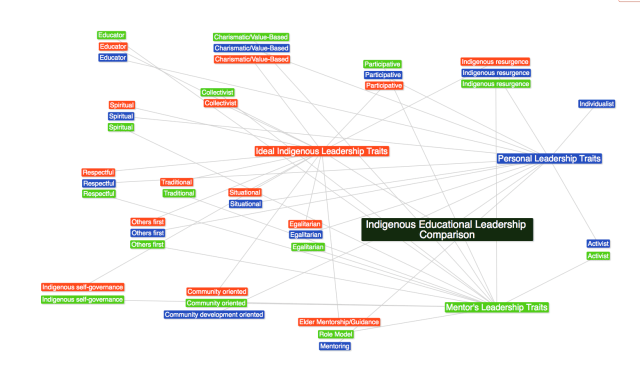
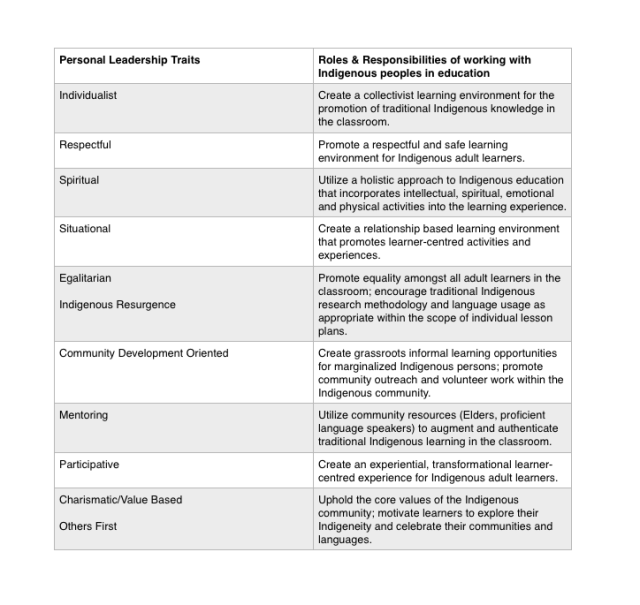
There have been three Indigenous educators whose activism and research in Indigenous resurgence have inspired me to follow my current pathway; Taiaiake Alfred, Jeff Corntassel, and Leanne Simpson. Taiaiake Alfred (Kanien’kehaka) has been the most influential, though I have challenged some of his Indigenous resurgence ideology during my undergraduate studies in adult education, specifically his early discussion on preserving traditional Indigenous knowledge that directly related to Indigenous self-governance, above the preservation of other traditional knowledge (Alfred, 2009). Jeff Corntassel (Tsalagi) came to my attention through the works of Taiaiake Alfred, as they both hold positions within the Indigenous Governance department at the University of Victoria; his tenacity for vocalizing the validity of Indigenous research methodology within academe (Corntassel, 2003), is one of the reasons I consider him a role model in the field of Indigenous education. Leanne Simpson’s (Anishinaabe) research in the field of Indigenous resurgence caught my attention, as she focuses on Indigenous theory and philosophy using storytelling as an Indigenous research methodology, while promoting the reclamation of traditional Indigenous languages (Simpson, 2011). While these scholars and activists are not the only ones in their chosen fields, they are the ones that initially drew me toward the study of Indigenous resurgence, and the pursuit of professional development within the field of Indigenous educational leadership. Figure 1-1 (above) is a comparison between my own leadership styles, the leadership styles I have observed from my most influential role model (Taiaiake Alfred), and what I perceive to be an ideal Indigenous leadership model. From this comparison, a conceptual framework (Fig. 1-2 below) emerged:
References
Alfred, T. (2009). Peace, power, righteousness: An Indigenous manifesto (2nd ed). Don Mills, ON:Oxford University Press.
Corntassel, J. (2003). An activist posing as an academic?. American Indian Quarterly, 27(1/2), 160-172.
Northouse, P.G. (2016). Leadership: Theory and practice (7th ed.). Los Angeles, CA: Sage.
Rooke, D. and Torbert, W.R. (2005, April). Seven transformations of leadership. Harvard Business Review. Retrieved from: https://hbr.org/2005/04/seven-transformations-of-leadership
Simpson, L. (2011). Dancing on our turtle’s back: Stories of Nishnaabeg re-creation, resurgence, and a new emergence. Winnipeg, MB: Arbeiter Ring Publishing.
Whitinui, P., McIvor, O., Roberston, B., Morcom, L., and Cashman, K. (2015). The World Indigenous Research Alliance (WIRA): Mediating and mobilizing Indigenous peoples’ educational knowledge and aspirations. Educational Policy Analysis Archives, 23 (120), 2-25.

