
Part II: Profile of Taiaiake Alfred (Kanien’kehaka)
“Reclaim, rename, reoccupy” (Concordia, 2015), are the words spoken by Indigenous Governance professor (UVic), Taiaiake Alfred, in a speech at Concordia University, discussing the role of universities in support of Indigenous resurgence. These three words are incredibly powerful in the discussion of Indigenous resurgence within the university, which itself is a Eurocentric educational construct that is oppositional to traditional Indigenous ways of learning and knowing (Alfred in Tehran Toronto, 2012). Alfred suggests (right or wrong) that the university is impervious to Indigenization, and that our role as Indigenous educational leaders, is to carve out an Indigenized space within the Eurocentric construct, where Indigenous knowledge mobilization is promoted as validation of Indigenous research methodology (Alfred in Tehran Toronto, 2012).
As an educational leader, Alfred is fluid and dynamic, continuously challenging his own assumptions on Indigenous resurgence and Indigenous leadership in higher education. His earlier works act in promotion of ‘self-conscious traditionalism’, the ideology that promotes selective use of traditional Indigenous knowledge for the purpose of reclaiming traditional Indigenous governance of our lands, for the betterment of Indigenous communities (Alfred, 2009), often at the expense of other aspects of traditional Indigenous knowledge preservation. From here, Alfred moves toward the promotion of Indigenous feminism through an egalitarian masculine (warrior) lens, that suggests that female Indigenous educational leadership need be cognizant of the balance of power in traditional Indigenous relationships, working to show strength in traditional matriarchal leadership roles without emasculating the male voice within the Indigenous community (Alfred, 2011). The next evolution in Alfred’s educational leadership comes as he reframes his understanding of Indigeneity as Indigenous resurgence, acknowledging its liberating and transformative power in the decolonization process, for both Indigenous and settler ally learners (Alfred, 2013).
Reflecting on Alfred’s Indigenous educational leadership, and his viewpoint on Indigenizing the academy (Alfred in Tehran Toronto, 2012), I am left with one question: How can we finally achieve a fully egalitarian higher education system in North America, where Indigeneity is embraced instead of devalued or segregated within an Eurocentric construct; furthermore, is it possible to Indigenize the workplace utilizing Indigenous resurgence ideology?
Strategizing on Indigenizing workplace learning
Reflecting on the Indigenous educational leadership characteristics of various Indigenous educator role models, strategies for developing Indigenous education in the workplace have emerged:
- Incorporation of Indigenous pedagogy into workplace learning initiatives; this strategy provides for optimal experiential learning in on-the-job training situations that facilitate one on one mentoring in technical skills development.
- Promotion of Indigenous research methodologies for exercises in organizational problem solving.
- Promotion of Indigeneity in workplace; create a safe space for Indigenous communities to thrive in the workplace
- Incorporation of holistic/balanced learning into the workplace.
- Engage in Indigenous resurgence; promote the use of traditional Indigenous knowledge in the workplace.
Part III: Workplace Community Leadership Model
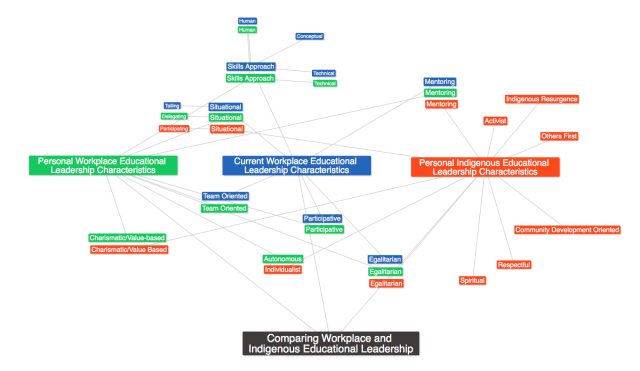
The educational leadership characteristics typically found within the scope of technical skills development in the workplace (based upon models experienced while engaging in civilian and military workplace instructional roles), as well as personal workplace educational leadership, and personal Indigenous educational leadership characteristics have been visually compared and contrasted (Fig. 1-1). The disconnect between workplace and Indigenous educational leadership characteristics is noteworthy, as well as disconcerting; as is the realization that the fluid nature of leadership promotes the compartmentalizing of leadership characteristics dependant on the educational leadership role. This compartmentalization of educational leadership characteristics, with a suppression of Indigenous leadership traits, gives voice to the overwhelmingly exclusive Eurocentric nature of the workplace.
At this moment, the words of Taiaiake Alfred ring out, “reclaim, rename, reoccupy” (Tehran Toronto, 2012), as the words ‘Indigenous resurgence’ stand out in Figure 1-1. Now is the time to Indigenize the workplace! Taking on an activist role in the promotion of Indigenous education leadership and pedagogy in the workplace, our Indigenous communities and their educational leadership are able to work toward decolonizing the workplaces our Indigenous peoples occupy. Indigenous knowledge mobilization coupled with utilizing Indigenous research methodology acts to promote innovation and transformation (ResearchImpact, 2014), of organizational problem solving capabilities. The possibilities for incorporating Indigenous resurgence ideology, and Indigenous educational leadership into the needs of the Eurocentric workplace are endless, and only limited by the continued compartmentalization between workplace educational leadership and Indigenous educational leadership. Reclaiming Indigeneity and validating the Indigenous voice in the workplace are the future of workplace learning.
References
Alfred, T. (2009). Peace, power, righteousness: An Indigenous manifesto (2nd ed.). Don Mills, ON: Oxford University Press.
Alfred, T. (2011, November 24). Indigenous masculinity and warriorism [Web log post]. Retrieved from: http://taiaiake.net/2011/11/24/81790039/
Alfred, T. (2013, December 13). Being and becoming Indigenous: Resurgence against contemporary colonialism [Web log post]. Retrieved from: http://taiaiake.net/2013/12/13/being-and-becoming-indigenous-resurgence-against-contemporary-colonialism/
Concordia University (2015, May 1). What can universities do to support Indigenous resurgence? [Video file]. Retrieved from: https://www.youtube.com/watch?v=cVGiYmNTP1w
RESEARCHIMPACT (2014, November 27). So what the heck is knowledge mobilization and why should I care? [Web log post]. Retrieved from: https://www.youtube.com/watch?v=7FL8wKpdUvA
Tehran Toronto (2012, April 12). Taiaiake Alfred: Indigenizing the academy [Video file]. Retrieved from: https://www.youtube.com/watch?v=7FL8wKpdUvA


Nice to see you’re still writing! All the best on your master’s.
Dave
Thank you, Dave. I appreciate the support!
Cindy